
Dispatch from the Happy Whale
Part 1

Editor's Note:
We talk a lot about the writer acting as a distorted lens. But here, A.P. Murphy takes that lens to a decaying, noise-polluted stretch of coast and turns it completely inward.
A radical line of flight where the 'I' dismantles itself into a shoreline.
— Mac Sitko
A memoir, partly of growing up in the UK, partly of a youth spent in Barcelona, and mostly of a mid-life episode spent in an abandoned campsite.
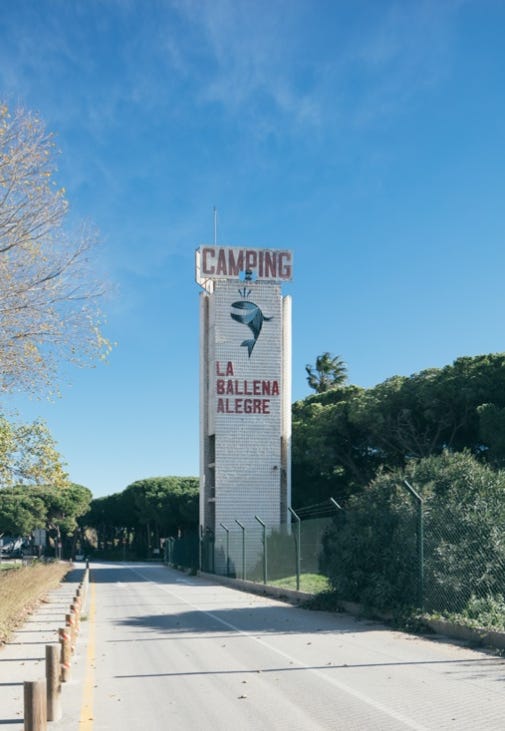
An experiment: how long can one survive on just chocolate powder and sunshine, with only a katana for company? The beach doesn’t answer and doesn’t know. It knows only the repetitive hiss of waves breaking on it always. The abandoned campground answers only with its own emptiness. It may well know how survival is granted, given that it has lasted for so long without the human occupants it was built to gather in companionship. But it’s not telling.
There’s thirst of course: there’s always thirst.
But this may be why I
 (why ‘I’? – there is no real ‘I’ even remaining anymore
     – why ‘I’? –
        because syntax demands that an everpresent
          ‘I’ be here to hold the hand of the verb,
                 and all the time...
                  ‘I’ don’t even really exist
                      beyond thirst and the sharp edge of the blade
                         and the hiss of waves on the beach)
why I (tedious, insistent ‘I’ – can you not be silent?)
why I carry a Camelbak full of water at all times which gives three or even four days of life, time enough for our purposes.
Time enough for the experiment to get underway at least.
How long can one survive when the gleam at the edge of the sword is itself its own thirst?
Wife and kids gone to the island, to her parents’ home. ‘I’ don’t do the island, it’s one of the only remaining fragments of ‘I’ that is distinct from the off-white colour of the walls or the neutral wafting of air on a light breeze. Only quirks and snaggy reluctances define ‘I’ these days, an ‘I’ which is soon to be downgraded down to lowercase, an ‘i’ of the most minimal outline imaginable, immense in heavy felt fleshiness but so faint in presence that i dwindle to inane irreality.
Family gone, a city apartment to inhabit alone. But discontent leaks through the walls like iridescent ooze, an urge to do something manifests like protoplasm out of thinnest domestic air. The urge firms up, becomes a thing. The thing is to break away.
The fragmented bits of ‘i’ remaining (‘we’? – a collective of personshards, an unstable amalgam of subjectivities) cast our minds back on another time, another ‘i’ that we now know as a historical ‘he’. Just as probabilistic, just as plural as the ‘i/we’ of today, no doubt, but given body and coherence by the magic of melancholy and nostalgia.
‘He’ had to find a way to escape family mass on Sunday mornings. ‘He’ dreamt up some horseshit about needing to sleep late, about going to church for the evening mass. ‘He’ stepped out to find another spot to invade.
I decree today that life
is simply taking and not giving.
England is mine,
and it owes me a living
The term URBEX for “urban exploration” didn’t yet exist, so it was known only as trespass, property invasion, burglary, intrusion. It was the joy of bursting in to where you were not wanted. Old factories, construction sites, wharfs, overgrown islands with rusted spikes, hotels with the ghosts of ghosts who would shrink into the floorboards when you passed. (‘You’? – what is this chaos of pronouns, of shifting persons? Is nobody an anybody anymore?)
Best of all was the great old country house, abandoned and majestic in its decadence. There were dogs: guard dogs and feral hounds and perhaps also phantom curs from antiquity. But dogs are only dogs, and there are ways of becoming their friends so they will let you pass.
These things are known as stately homes – homes of state, houses that are stately and solemn like the corpse of a mighty emperor – and in other lands would be allowed to rot gracefully into the feral ivy. But in this nation of shopkeepers turned marketing consultants, the crumbling palace would soon become a business venue and well-known set for country-house TV dramas.
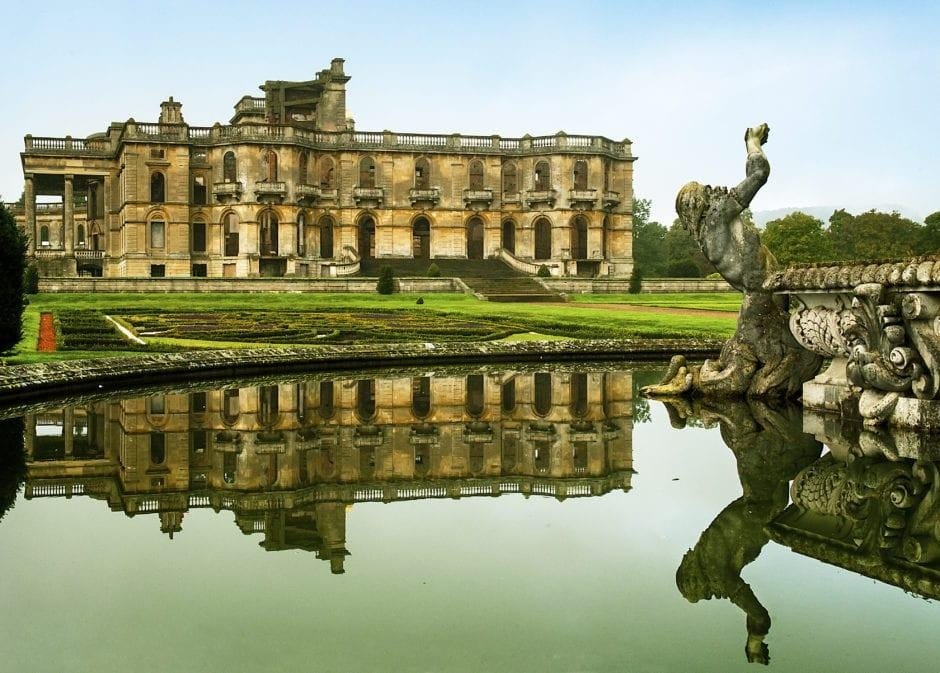
‘He’ says: I’ve lost count of how many times I’ve since seen the magnificent fireplace as the backdrop to some melodrama of lords and debutantes and thought “that’s where I took a piss while the groundsman’s labrador sniffed my emissions and joined in to mark our shared territory.”
It took twenty-two minutes to pack up the gear and get out. Gear included: portable solar-panel mat to charge phone and batteries, med kit including bandages and iodine, foam mat and army sleeping bag, sachet of chocolate powder, Camelbak of water, towel. Did not include: sun protection cream, actual solid food, swimwear. In a separate shoulder-slung bag for hockeysticks was the katana in its saya scabbard.
Why? Because the warrior goes nowhere without his sword. Because he’s just discovered the fun of swooshing off a hundred grass-stalk heads in one movement. Because the edge of the blade is its own special thirst.
A short bus ride just beyond the airport – people glancing askew at the overburdened guiri in beachfront drag, pudgy pale flesh conspicuous by its indoorsness – and there it is: The Happy Whale.
Paradise abandoned.
La Ballena Alegre was the most innovative design-driven and bauhaus-ass campground in the world when it opened in 1965. Famed photographer Francesc Català Roca came to shoot snaps of the cutting-edge minimalist structures of the cafeteria and the communal showers. The logo of the happy whale was a well-known sight for those heading south along the coastal highway.
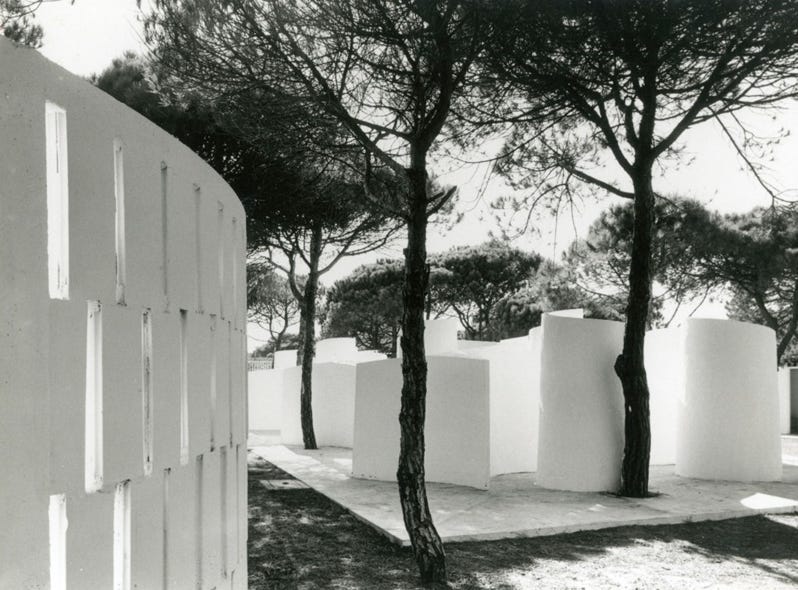
In the Olympic years we always used to pass it on the way to the gitano ghetto out by Viladecans where we would go to purchase hashish. The Happy Whale was for us an emblem of the delicious friction of streetcrime, of car wrecks and guys with mysterious angular bulges in their shellsuits and missing teeth and elegant mullets and of us being hugely stoned on the drive home.
In post-Olympic years the campground was shut down. The airport was extended and the takeoff paths routed to go directly over the space. Huge jets would belly up, the cranking of their undercarriage audible under the liftoff roar, every minute. The site was recoded non-residential and the place was evacuated.
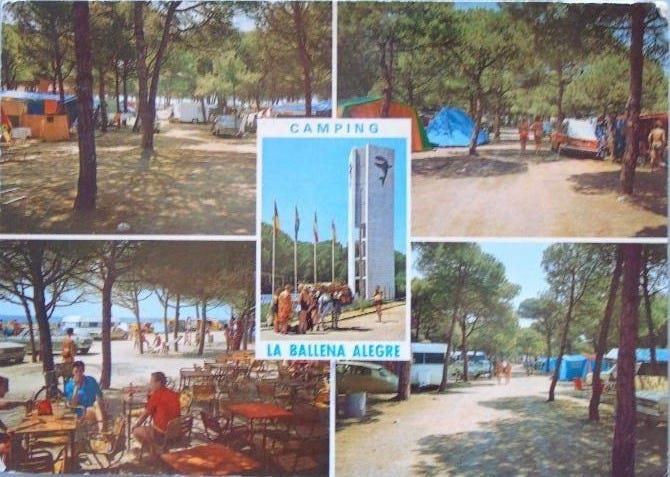
It became a deserted paradise on some of the most desirable beachfront property in the world, its only downside being a level of noise pollution that would be classified as illegal torture, a crime against humanity, if it were inflicted anywhere else than a CIA black site.
On arrival the first thing to notice is that the entire campground is surrounded by four-metre-high chainlink fence topped with razorwire – but no security cameras. The second thing to notice is that there is a security patrol, a guy in an Opel Astra marked with private cop logo, who makes the rounds every four hours. Easy peasy.
There is a rule in the invasion of private spaces that there is always a way in, a spot that is overlooked, a weak point in all the vigilance and in the perimeter defences. Here it is: just behind where the fence loops around an outbuilding, there’s a hole in the fence that’s been patched. Amateur work: the new section, a mismatched and obviously patched-in swathe of chainlink, can be easily bent out to allow a slim person to squeeze through. Or even a fat pasty slob with a backpack and a hockeystick bag.
Paradise regained.
Continues here - PART 2: Happy Whale Days and The Daze of Noon
© 2026 NOPE Journal. All rights reserved. Don’t be a dick and steal our stuff.
 | A guest post by
|
The pronoun interruptions really pulled me into this very surreal atmosphere while reading this, fascinated to see where he/somebody/anybody ends up after this
Dizzying. Who is 'he' anymore?? Looking forward to seeing how he fares within the campground.